
Slidell Previous Residents by Era
The best source depends on the period and the fact being tested. Current parcel tools provide the starting identifiers. Clerk indexes and Archives extend the ownership trail, while tax rolls, newspapers, census schedules, maps, and any verified directory edition can add dated household context. Exact Slidell city-directory years were not verified, so the table does not invent a run.
| Source | Years It Covers | Where Held | What It Shows |
|---|---|---|---|
| Current assessment and GIS | Current roll and map | St. Tammany Parish Assessor | Assessment number, owner field, legal description, parcel shape |
| Land index and images | Book data from July 1, 1961; images from 1977 | Clerk Cott and legacy transition | Grantors, grantees, instruments, legal descriptions |
| Archive conveyances | 1810–1921 | Clerk Archives, Covington | Earlier owners, transactions, descriptions |
| Property-tax archives | 1880–1940 | Clerk Archives | Owner and assessment history |
| St. Tammany Farmer | 1878–1960 microfilm | SLU regional collection | Legal notices, obituaries, property and family clues |
| Sanborn map set | March 1926 | Library of Congress | Street grid, footprint, use, block position |
| Federal census | Through the latest public schedule | National Archives and library databases | Dated households and enumeration context |
For a recent transfer, start online and verify the instrument. For a trail that reaches the early twentieth century, shift to Archives and tax material. Use maps and newspapers as checkpoints, then ask librarians about editions and local files that are not visible in the public catalog.
Begin With the Slidell Parcel
Enter the current physical address in the St. Tammany assessment search. Record the assessment number, roll year, owner field, property description, subdivision, lot, square, and mailing address. Next, open the Assessor GIS and compare the mapped polygon with that description. The owner field is an assessment fact, not a certified deed statement or proof of residence.
Keep mailing and situs fields apart. Situs means the physical property location. The deed appearance clause controls the mailing address used for tax bills, so it may point far from the Slidell parcel. If the street search fails, the Assessor notes that a parcel can exist without a clean physical-address match. Use the assessment number or subdivision and lot, then bridge to a Clerk plat.
Note: Save the assessment year and GIS capture date because the text roll and live parcel map may update on different schedules.
Walk St. Tammany Deeds Backward
A chain of title is the linked sequence of recorded transfers for a property. Start with the present assessment only to find the likely owner and stable legal description. Then use the Clerk's land-record gateway to locate the recorded purchase. Current Cott access, the legacy portal during its transition period, the Recording counter, mail requests, and Archives are separate channels.
- Copy the current assessment number and legal description exactly.
- Find the current owner's purchase instrument in the Clerk index and verify the parcel description.
- Search the seller, or grantor, as an earlier grantee to locate that person's purchase.
- Repeat while recording instrument number, book and page, date, document type, parties, and map reference.
- When the portal's coverage ends, request the correct deed book, mortgage series, tax roll, or archive file by name, description, and date.
- Grantor and grantee
- The grantor transfers an interest; the grantee receives it.
- Chain of title
- The connected sequence of instruments transferring rights in the same land.
- Legal description
- The recorded land description, often using subdivision, lot, square, ward, plat, or measured boundaries.
Use the actual instrument or certified copy for a legal conclusion. A preliminary status line, index typo, or missing online image is not enough.
Slidell Previous Residents in Archives
The St. Tammany Parish Clerk Archives is the essential fallback once a deed trail moves beyond modern portal coverage. Its official page is the source for research categories and request routes.
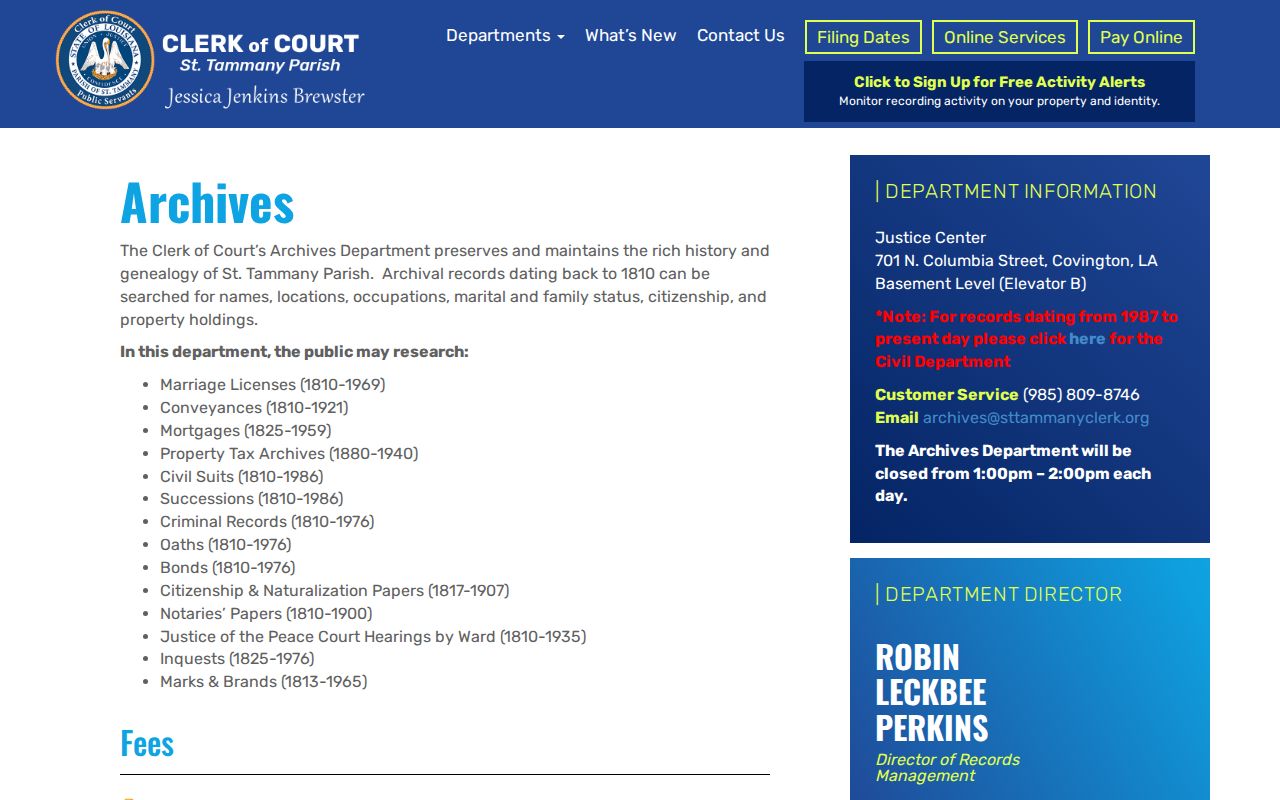
The Archives holds conveyances from 1810–1921, mortgages from 1825–1959, and property-tax records from 1880–1940. It also keeps successions and civil suits from 1810–1986, plus marriage, naturalization, notarial, inquest, and other series with their own date ranges. These collections begin in 1810, much earlier than current online land images.
Visit the Justice Center basement in Covington, call 985-809-8746, email archives@sttammanyclerk.org, or use the archive copy forms and mail route. Supply a person, approximate date, property description, ward, and known instrument or book reference. Fragile files may limit copying. The Slidell Annex handles many land and customer services, but not every historical archive function.
When a Slidell Address Disappears
An older deed may omit the street number and instead name a lot, square, subdivision, ward, bayou, or metes-and-bounds line. The legal description is usually the stable bridge. Compare it with a recorded plat and current GIS rather than forcing an old label into a modern search box.
Street and municipal context also change. Olde Towne material supplies dated block and boundary clues, while a 2021 city zoning packet documents a pre-November 4, 1986 city-status reference for one property. Neither is a universal annexation chart. Use each only for the property and date it covers.
A no-match should trigger variants and fallbacks: street suffixes, subdivision and lot, map reference, Archives, the city custodian, newspapers, and library staff. Record the unsuccessful query so it is not repeated as if it proved absence.
Map Slidell House History
The March 1926 Slidell Sanborn set has seven sheets. It can date a street grid, cross street, block, building footprint, and mapped use. The city's 2021 historic-resource survey adds a list of 230 surveyed buildings. These sources may show that a structure existed at a point in time, but they do not identify every person inside it.
Compare three different records: a Sanborn footprint for the building and date, current GIS for today's parcel geometry, and a recorded deed for a legal transfer. A change in footprint without a deed change may reflect construction. A parcel split or consolidation can make one current polygon a poor match for an older address.
That contrast is the heart of good house research. Maps locate and date places; deeds transfer land interests; personal sources connect named people to dated events.
Date Slidell Residents in Newspapers
Southeastern Louisiana University's St. Tammany Historical Society collection includes St. Tammany Farmer microfilm from 1878 through 1960. Rolls 24 and 25 are missing in the listed 1935–1936 sequence, so a blank search in that span needs another newspaper or repository. Legal notices, obituaries, society items, election reports, and property advertisements can connect a name, address, and event date.
The Slidell Sentry and Times-Picayune are additional routes. St. Tammany Parish Library offers newspaper and genealogy databases with card or in-library limits. Search a surname variant, street variant, spouse or relative, and a narrow event window. Capture publication, issue date, page, and exact role.
A newspaper mention is a checkpoint, not proof of continuous residence. Pair a sale notice with its recorded instrument, an obituary with cemetery or succession evidence, and an address mention with a map or tax record.
Ask Slidell and Covington Librarians
The Slidell reference desk and Covington genealogy desk are distinct human access channels. Slidell reference staff can be reached at 985-646-6470, press 3, or ref-slidell@stpl.us. Covington genealogy staff use 985-893-6280, press 6, and genealogy-covington@stpl.us.
Ask for a shelf or microform check for city directories, reverse directories, telephone books, yearbooks, obituary indexes, vertical files, local maps, and house-history material. A direct public catalog query for “slidell directory” returned no visible result during research, so a librarian check matters. Do not turn the verified 1855 and 1861 New Orleans directory examples into Slidell coverage.
The Slidell branch itself moved several times before opening at 555 Robert Boulevard in 1989. That institutional history helps explain why an older local file may require staff knowledge rather than a simple current catalog query.
Connect Slidell Past Households
Owners are only one layer. A verified alphabetical directory can connect a name to a printed address, while a reverse or street section can turn an address and year into names. The exact local editions and their reading methods belong on the Slidell city directory page. Census schedules add household relationships and enumeration context for public census years.
- Choose a deed, tax, obituary, voter, or map date as the anchor.
- Check the nearest verified directory edition and cite its edition and page.
- Locate the address in the closest public census using street, household, and enumeration clues.
- Compare names and ages without merging spelling variants too soon.
- Use obituaries, cemetery records, marriage files, or succession records to test family links and endpoints.
Obituary and cemetery research may lead to the Louisiana Biography and Obituary Index, parish cemetery print sources, selected microfilm, maps, and funeral-home material. Successions can identify heirs and property, but request the exact file rather than assuming a name match belongs to the address.
Lawful use. Research Slidell previous residents for lawful house history, family history, estate work, or personal curiosity. Never use a historical trail to track, harass, or harm a living person.
Build a Slidell Source Chain
Create one line for each finding: source, date, person, role, address as printed, legal description, instrument or page, access route, and caveat. For deeds, add grantor, grantee, map reference, image count, and certification status. For newspapers and directories, preserve the issue or edition and page. For maps, save the sheet, scale, and block.
Conflicts should remain visible. A tax mailing address can differ from the physical parcel. A sale date can precede recording. A directory can lag a move. An obituary can name a former home. Two independent records with compatible dates and roles make a stronger link than repeated copies of the same index entry.
Previous residents research ends with a dated evidence chain, not a claim that every occupant has been found. State what is verified, what is inferred, and which archive, counter, mail, library, or online route was checked.