
Slidell City Directory Source Shelf
A Slidell city directory search needs an honest coverage ledger. The St. Tammany Parish Library catalog showed no visible result for the exact query slidell directory during research. That is a finding, not proof that no volume exists. Reference staff can check uncataloged local files, microform, yearbooks, phone books, and nearby parish titles. Meanwhile, several dated collections supply the same kinds of name, place, and household evidence.
| Collection | Years | Where Held | Access |
|---|---|---|---|
| Slidell printed or reverse directories | Exact years not verified | St. Tammany Parish Library | Ask staff for shelf and microform check |
| Clerk historical series | 1810 onward, varying by series | St. Tammany Clerk Archives | In person, mail, and series-specific copy forms |
| St. Tammany Farmer | 1878-1960, rolls 24-25 missing | SLU Center for Regional Studies | Microfilm with staff help |
| Historic voter registrations | 1867-1949 | FamilySearch, courthouse originals | Indexed digital collection and library access |
| Slidell Sentry | 1966-1999 | Library of Congress record | Catalog record and repository follow-up |
The table separates verified coverage from open questions. Two New Orleans editions, Cohen's 1855 directory and Gardner's 1861 directory, appear in a library genealogy case study. They show that directory research is available through the library, but they do not establish Slidell coverage. Never relabel them as local volumes. Ask staff to record the title page, publisher, year, format, branch, call number, and whether a found volume is alphabetical, telephone-only, street ordered, or reverse.
Verify Slidell Directory Years
The human access channel matters here. Slidell reference librarians can be reached at 985-646-6470, press 3, while Covington genealogy staff use 985-893-6280, press 6. Ask them to search “Slidell city directory,” “St. Tammany directory,” “telephone directory,” “reverse directory,” “Polk,” “Criss-Cross,” and “yearbook.” State the person, approximate year, street, and format sought.
The Slidell Branch moved several times after opening in 1950. It occupied City Hall, later 444 Erlanger Avenue, and then the current Robert Boulevard building. Older files may have been transferred or described under a former branch location. A reference answer should therefore name where the item was checked and when. This Slidell city directory method avoids turning a catalog gap into a false claim.
Note: A zero-result catalog screen calls for a staff shelf check, not a guessed publication year or publisher.
Slidell Library Genealogy Channels
The library genealogy hub lists in-branch and remote research tools, including FamilySearch, Ancestry Library Edition, Fold3, HeritageQuest, MyHeritage Library Edition, NewsBank, NewspaperArchive, and Times-Picayune historical files. Access differs by database. Some require a library card, and some work only inside a branch. Confirm the rule before making a trip.
These tools are companions to a city directory, not substitutes with identical fields. A census can group a household. A newspaper can fix an event date and spelling. A yearbook can place a student in a school year. Cemetery and obituary sources may explain why a name disappears. Save a citation for each record and avoid copying private credentials or broad personal details that do not serve the family-history question.
The City of Slidell also provides cultural and local-history contacts. Its Cultural and Public Affairs page is the source for museum and municipal history inquiries.
The official cultural office is a useful lead for local photographs, exhibits, and place references.
The captured page confirms the official contact route without implying that the city runs a searchable resident index.
Slidell Names Beyond Directories
The St. Tammany Historical Society collection at Southeastern Louisiana University gives the strongest dated newspaper run: St. Tammany Farmer microfilm from 1878 through 1960. Listed rolls 24 and 25 are missing in the 1935-1936 sequence. Search notices, legal advertisements, obituaries, election returns, society items, and property notices, then cite the newspaper date, page, and repository roll.
The same regional collection includes cemetery and marriage books, photographs, property papers, early family papers, and Riggs real-estate notebooks dated from 1936 to 1972. Those notebooks require staff help. For later local news, the Library of Congress record for the Slidell Sentry identifies coverage from 1966 through 1999. A newspaper mention proves what that dated item says. It does not by itself prove continuous residence.
Read Slidell Directory Entries
When staff locate a Slidell city directory, photograph or transcribe the title page and abbreviation key before the entry. Directory conventions vary by publisher and year. Record only what the page actually prints, including punctuation and symbols. An address may be a home, business, boarding place, or mailing point. The entry needs another dated source before it supports a firm identity claim.
| Edition and page | The exact volume, year, page, and image or shelf citation. |
|---|---|
| Printed name | Spelling, initials, suffix, and any spouse or household label. |
| Role | Occupation, firm, public role, or other description, if printed. |
| Address and phone | The street wording and telephone exactly as shown for that edition. |
| Marks | Owner, renter, widow, boards, residence, or other symbol only when the key defines it. |
- Criss-cross directory
- A volume or section arranged by street and house number rather than surname.
- Householder index
- A list centered on the person identified as the household head under the publisher's rules.
- Abbreviation key
- The publisher's legend for short forms and marks. It controls how each entry should be read.
A blank field has no safe meaning. It may reflect the publisher's survey method, an unlisted household, a missed canvass, or a person outside the edition's limits. Preserve uncertainty instead of filling it from a later source.
Slidell Residents in Parish Archives
The St. Tammany Clerk Archives reaches to 1810 and permits research by names, places, roles, family status, citizenship, and property. Its series include marriage licenses, conveyances, mortgages, tax rolls, civil suits, successions, naturalization, notarial papers, ward-level hearings, inquests, and marks and brands. This range is often more useful than forcing an early Slidell person into a modern street format.
Use the archive counter in the Covington Justice Center basement, mail, or the linked record-specific copy forms. Give a narrow name, date range, record type, and known number. Fragile items may have handling limits. The archive is closed from 1 to 2 each day, and research questions can go to 985-809-8746 or archives@sttammanyclerk.org.
The parish connection matters because Slidell is one city within St. Tammany Parish. The official Louisiana parish profile confirms that local government geography.
The official parish profile helps keep Slidell, St. Tammany Parish, and Covington custody roles distinct.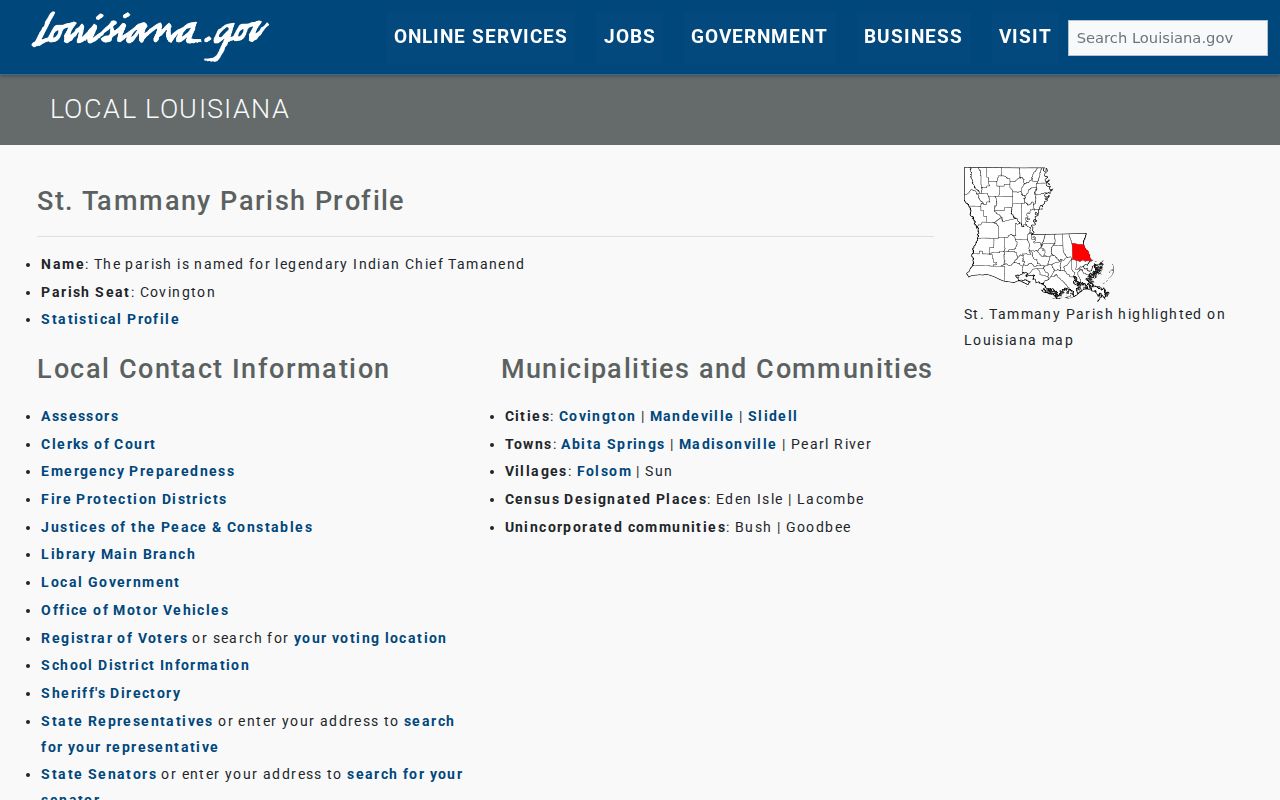
The image supports the jurisdiction check that should accompany every historical city directory citation.
Slidell Station Changes Search Terms
Place names shift across the record trail. Official local history describes “Slidell Station” as the railroad stop name in 1882, followed by city incorporation in 1888. Early records may use a station, ward, bayou, lot, square, or parish label instead of the modern street and city. Search those terms alongside the surname.
Olde Towne streets such as Erlanger, Fremaux, Bouscaren, and Cousin recur in historic material. The 1926 Slidell Sanborn map set can test street names, blocks, and building footprints. A Sanborn sheet gives historic physical context, not proof of who lived there. Pair it with a directory entry, deed, tax record, or dated newspaper.
| 1810 | Earliest St. Tammany Clerk archive holdings begin. |
|---|---|
| 1882 | Slidell Station railroad name appears in official local history. |
| 1888 | Slidell incorporated on November 13. |
| 1926 | Seven-sheet Sanborn set records historic blocks and buildings. |
| 1950 | Slidell's public library branch began. |
Trace Families Through Slidell Directories
A family-history trail works best when every step is dated. Begin with a secure record such as a deed, obituary, voter registration, or census entry. Then test the name against any Slidell city directory editions the library verifies. The goal is a chain of citations, not a smooth story built from guesses.
- Record the first confirmed name, date, role, and address from a source with a clear custodian.
- Check the nearest verified directory year, preserving initials, spouse labels, occupation, and page.
- Follow later editions one at a time. Note moves, spelling changes, and the last appearance.
- Use street or reverse sections only when the volume contains them, then compare the address with a census, map, tax roll, or deed.
- Close gaps with the obituary index, cemetery sources, historical voter files, newspapers, or an archive request.
A disappearance can mean death, relocation, omission, a missed canvass, or a change in how the publisher listed the household. The library obituary and cemetery guide points to a Louisiana Biography and Obituary Index, cemetery books, maps, microfilm, and funeral-home sources. Historical vital records move to the Louisiana State Archives after the state confidentiality periods. Together, those sources can explain a gap without pretending the city directory alone proves what happened.
For a modern one-person check after a historical find, use the separate Slidell resident lookup workflow. Keep historical and current evidence in different columns.